
For years, we’ve been told that weight loss comes down to one simple equation:
Eat less. Move more. Count calories.
But what if we’ve been focusing on the wrong thing?
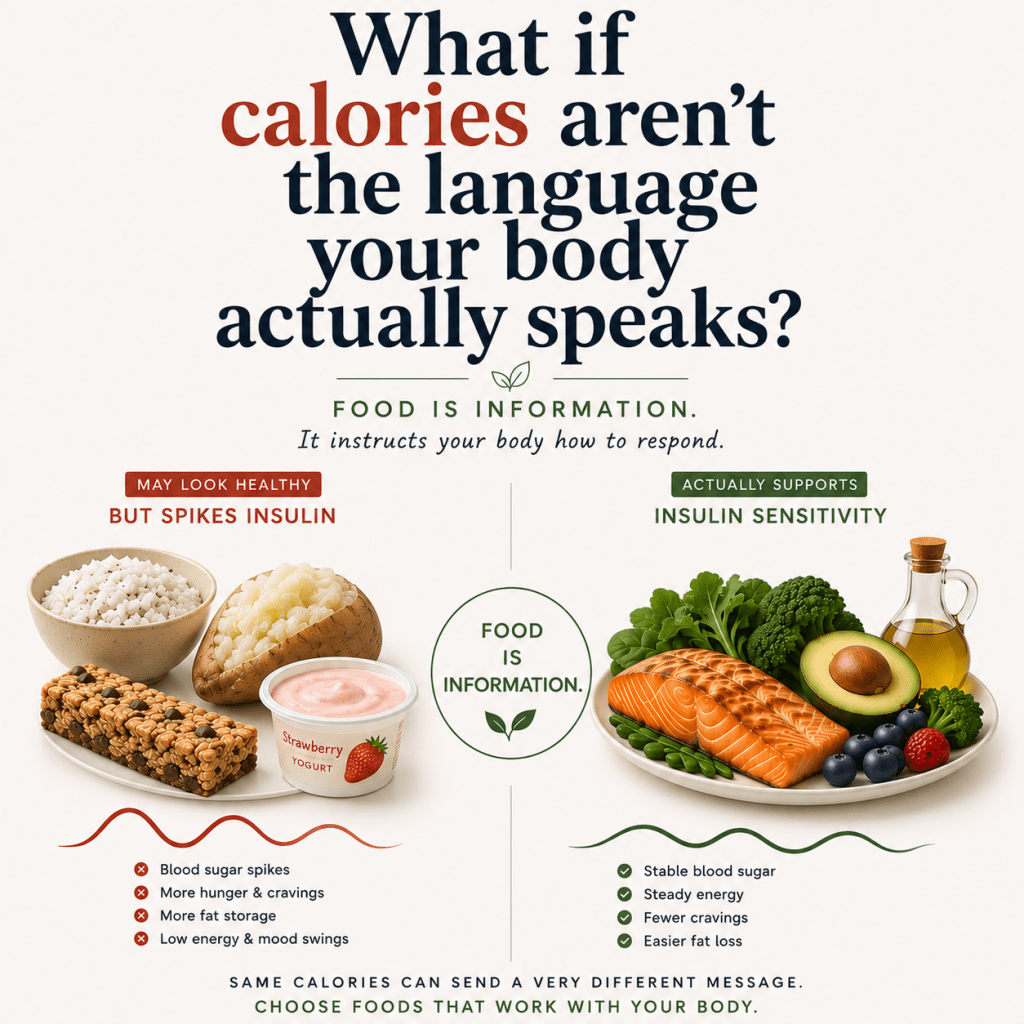
Calories measure the amount of energy in food, but they don’t explain how your body responds to that food. Your body doesn’t experience food as numbers. It experiences food as biology.
Every meal sends a message.
One of the body’s most important metabolic hormones receives that message: insulin.
Insulin’s job is to help move glucose from your bloodstream into your cells, where it can be used for energy. When your immediate energy needs are met, insulin helps store the excess for later—first in your muscles and liver, and then, if those stores are full, as body fat.
This is exactly what insulin is designed to do. It isn’t the enemy.
The problem begins when insulin stays elevated too often, for too long. Highly processed foods, frequent eating, chronic stress, poor sleep, and too little muscle activity all make it harder for your cells to respond to insulin. Your body compensates by producing more of it, creating a cycle known as insulin resistance.
When that happens, your body becomes less efficient. It has a harder time accessing stored energy. Hunger becomes louder. Cravings increase. Energy fluctuates. Fat storage becomes easier, while fat burning becomes more difficult.
This is why two meals with the same number of calories can produce very different results.
Imagine two meals with identical calories.
One consists of salmon, eggs, vegetables, and olive oil. The other is made up of refined grains, sugary foods, and processed snacks.
The calories may match, but the message they send your body does not.
One meal supports stable blood sugar, steadier insulin levels, and lasting satiety.
The other is more likely to create larger swings in blood sugar and insulin, leaving you hungry again sooner and reinforcing the cycle of insulin resistance.
This is why I don’t coach people to obsess over calories.
I coach them to restore metabolic efficiency.
We do that by choosing foods that nourish the body, building and maintaining muscle through regular movement, managing stress, prioritizing sleep, and allowing enough time between meals for insulin to return toward its baseline.
These aren’t rules. They’re ways of helping your body function the way it was designed to.
When insulin sensitivity improves, your body becomes more efficient at using the food you eat and accessing the energy you’ve already stored. Hunger becomes more reliable. Energy becomes steadier. Cravings begin to settle.
Instead of constantly fighting your body, you begin working with it.
My goal isn’t simply to help you eat less.
It’s to help you restore the conditions that allow your body to do what it was designed to do.
Because when your metabolism becomes more efficient, healthy weight is no longer just about willpower. It becomes the natural result of a body that is working well.


Leave a Reply